
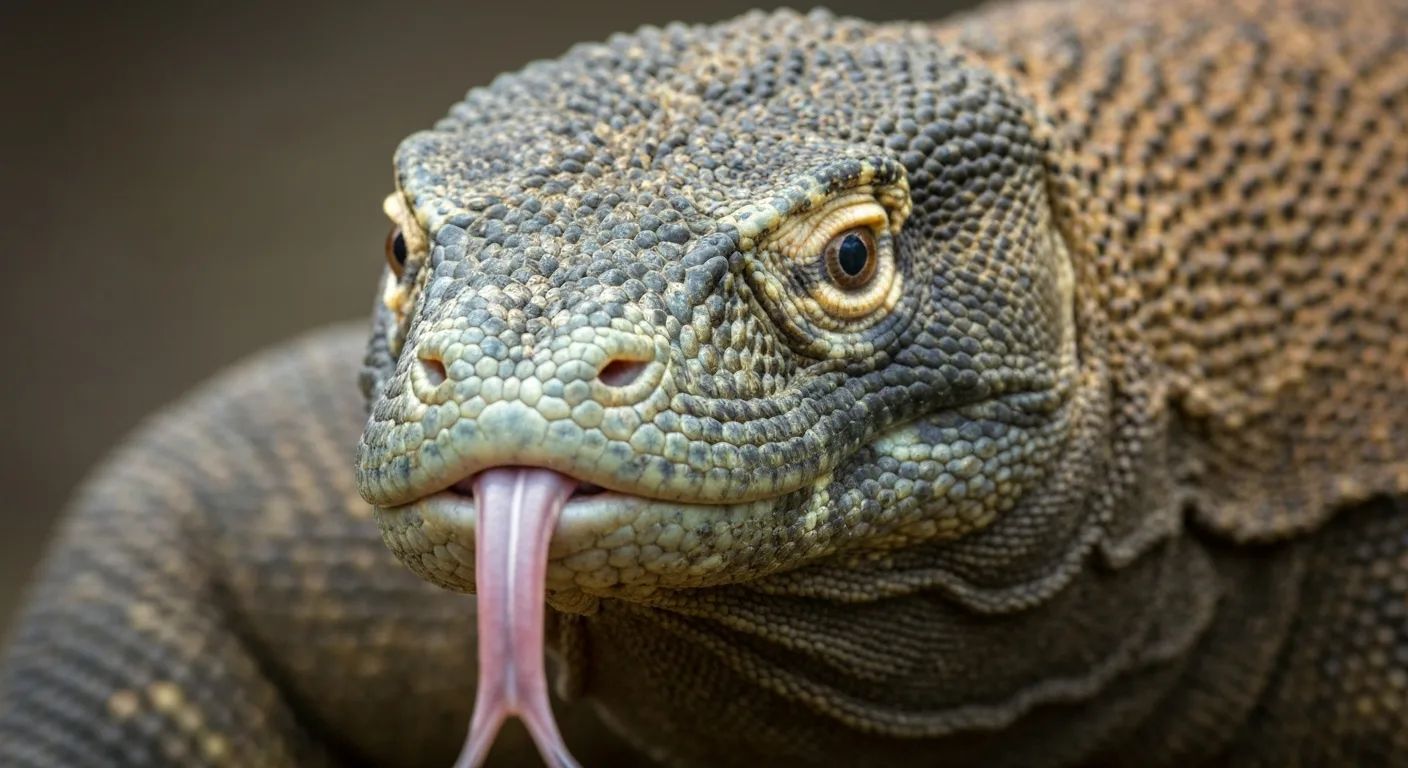
25 Fascinating Komodo Dragon Facts
Discover the extraordinary biology and behavior of Earth’s largest living reptile
Meet Dragons in PersonDragon Trek ToursQuick Answer: Dragon Essentials
Komodo dragons are the world’s largest lizards, weighing up to 360 pounds with venomous bites, unique hunting strategies, and complex behaviors. Endemic to Indonesian islands, they represent remarkable evolutionary success adapting to isolated island ecosystems over millions of years.
Size and Physical Characteristics
Fact 1: Komodo dragons are the world’s largest living lizards, with adults averaging 8-10 feet (2.4-3 meters) in length and weighing 150-200 pounds (68-91 kg). The largest recorded individuals exceeded 10 feet and weighed 360 pounds (163 kg), making them formidable predators despite being reptiles.
Fact 2: Their bodies are covered in rough, dark scales that vary in coloration from black to reddish-brown. The scales provide protection from injuries during hunting and territorial disputes. Male dragons often display brighter coloration than females, potentially related to sexual signaling.
Fact 3: Dragons possess powerful legs, massive claws, and strong muscular tails comprising approximately one-third of their total body length. Their tails serve as weapons during combat, fat reserves, and balance mechanisms for rapid movement. The combination of powerful limbs and sharp claws makes them formidable hunters capable of subduing large prey.
Venom and Hunting Capabilities
Fact 4: Komodo dragons possess venomous glands in their mouths, making them among the few venomous lizards. Their venom contains anticoagulants and hypotensive compounds that reduce blood pressure, contributing to prey incapacitation. The venom delivery system evolved independently from snake fangs, representing a distinct evolutionary solution to prey subdual.
Fact 5: Dragons are ambush predators relying on patient stalking and explosive strikes rather than sustained pursuit. They can consume up to 80% of their body weight in a single meal, then fast for weeks while digesting enormous food quantities. This feast-and-famine feeding pattern minimizes hunting frequency in resource-limited island environments.
Fact 6: Their primary prey includes wild boar, deer, smaller dragons, and occasionally water buffalo. Dragons employ coordinated hunting strategies, with multiple individuals sometimes working together to subdue large prey. Young dragons consume smaller vertebrates and insects. This dietary diversity demonstrates remarkable ecological flexibility.
Biology and Reproduction
Fact 7: Female Komodo dragons reach sexual maturity around 8-9 years old, while males mature slightly earlier. Females lay 4-30 eggs per clutch in burrows or abandoned megapode nests. Incubation takes approximately 8-9 months, with hatchlings emerging measuring only 16 inches (40 cm) long but already equipped with sharp teeth and venom.
Fact 8: Komodo dragons exhibit remarkable reproduction flexibility including parthenogenesis—females can reproduce asexually when males are unavailable. This reproductive strategy enhances population resilience in isolated island populations. Genetic analysis reveals this capability has occasionally prevented population crashes in conservation history.
Fact 9: Lifespan in the wild reaches approximately 30-50 years, though captive specimens have lived longer. Slow growth rates and delayed sexual maturity contribute to long lifespans. These demographic characteristics make dragons vulnerable to overhunting and require long-term conservation commitment to maintain viable populations.
Behavior and Social Structure
Fact 10: Dragons are primarily solitary animals establishing home territories spanning several kilometers. Males defend territories from rivals through combat, resulting in visible scars and missing toes. Dominance hierarchies emerge when multiple dragons encounter food sources, with larger individuals typically securing priority access.
Fact 11: Territorial combat involves dramatic displays including body inflation and tail thrashing before physical engagement. Dragons bite, claw, and attempt to flip opponents, with battles sometimes lasting hours. Injuries are common but rarely fatal, with defeated dragons retreating to avoid further confrontation.
Fact 12: Young dragons are highly cannibalistic, with larger juveniles consuming smaller littermates and younger dragons. This adaptation reduces competition within limited island resources while creating a natural population control mechanism. Adult dragons also consume juvenile individuals when encountered.
Evolution and Endemic Status
Fact 13: Komodo dragons are endemic to the Lesser Sunda Islands of Indonesia, existing naturally nowhere else on Earth. Their closest living relatives are the smaller monitor lizards found in Australia and Southeast Asia. Paleontological evidence suggests they descended from Australian ancestors that colonized Indonesian islands millions of years ago.
Fact 14: Evolution on isolated islands created gigantism—the tendency for animals to grow larger in isolated ecosystems with limited competition. The absence of large predators allowed Komodo dragons to dominate their niches, evolving to massive sizes over millions of years. This phenomenon mirrors megafauna development on other isolated island systems.
Fact 15: Dragon populations on different islands display genetic variation reflecting isolated evolution. Komodo and Rinca populations show distinct characteristics, suggesting extended population separation. Genetic diversity is crucial for long-term population survival and conservation strategy planning.
Sensory Abilities and Physiology
Fact 16: Dragons locate prey using a combination of sight, smell, and heat detection. Their forked tongues collect chemical particles from the air, ground, and prey, conveying information to the vomeronasal organ for detailed scent analysis. This sophisticated chemical detection system enables tracking of distant prey and navigation across home territories.
Fact 17: Their eyes are relatively small but provide good daytime vision adapted to hunting in open sunlit environments. Like most reptiles, they have limited ability to see colors compared to birds or mammals. Thermal imaging capability remains scientifically debated, though some evidence suggests heat detection sensitivity.
Fact 18: Dragons are ectothermic, relying on environmental heat sources to regulate body temperature. They bask in morning sunlight to elevate internal temperature, enhancing metabolic rates for hunting. This thermoregulatory strategy allows survival in resource-limited environments by minimizing energy expenditure compared to warm-blooded mammals.
Ecological Role and Conservation Status
Fact 19: As apex predators, Komodo dragons regulate prey populations and shape ecosystem dynamics through predation pressure. Their diet influences wild boar and deer populations, affecting vegetation patterns and overall ecosystem health. Removing dragons would fundamentally alter island ecosystems with unpredictable cascading consequences.
Fact 20: Komodo dragons are listed as Vulnerable on the IUCN Red List, reflecting concerns about limited populations and restricted range. Population estimates range from 3,000-5,000 individuals, making them susceptible to environmental catastrophes. Conservation programs focus on habitat protection, population monitoring, and human-wildlife conflict mitigation.
Fact 21: Habitat loss from human settlement expansion and climate change threatens dragon populations. Rising sea levels endanger low-lying habitat while changing precipitation patterns affect prey availability. International conservation partnerships focus on protected area management and emerging threats monitoring.
Human Interactions and Notable Incidents
Fact 22: While attacks on humans are rare given that dragons naturally avoid humans and tourism occurs under strict guide supervision, documented incidents demonstrate their danger. Most incidents involve individuals ignoring safety protocols or entering unauthorized areas. Fatalities are exceptionally uncommon with proper precautions.
Fact 23: Local communities historically coexisted with dragons, developing cultural traditions and folklore about these creatures. Some communities view dragons with reverence, while others focus on practical wildlife management balancing human needs with conservation. Traditional knowledge contributes valuable insights to modern conservation strategies.
Fact 24: Zoos and research facilities maintain small captive populations supporting conservation breeding programs. Captive dragons provide research opportunities advancing understanding of behavior, reproduction, and health management. These populations serve as genetic reserves supporting future wild population recovery if necessary.
Scientific Wonder and Future Research
Fact 25: Komodo dragons remain subjects of intense scientific study with researchers investigating venom components for potential pharmaceutical applications, genetic mechanisms underlying gigantism, behavioral complexity, and ecosystem interactions. Each discovery advances understanding of reptile biology and island ecosystem dynamics. Future research will likely reveal additional remarkable capabilities and adaptations in these prehistoric-appearing creatures.
Are Komodo dragons related to dinosaurs?
Komodo dragons are modern reptiles, not dinosaurs. They evolved relatively recently (within the last few million years) compared to dinosaurs which went extinct 66 million years ago. However, they represent living examples of large reptilian predators similar to prehistoric forms.
Can dragons climb trees?
Young dragons are excellent climbers, regularly ascending trees to hunt birds and escape larger predators. Adult dragons rarely climb due to their massive size making tree navigation difficult and potentially dangerous. Juveniles depend on climbing as a survival strategy in competitive environments.
How fast can Komodo dragons run?
Dragons reach speeds up to 13 mph (21 km/h) in short bursts, though sustained running quickly exhausts them. Their ambush hunting strategy relies on explosive acceleration rather than sustained speed. They cannot outrun large prey in extended pursuits.
Do dragons sleep?
Yes, dragons rest and sleep regularly. They often rest in burrows, under rocks, or in shaded areas, particularly after consuming large meals. Sleep patterns are difficult to observe in wild populations but captive observations confirm regular rest periods.
Can dragons swim?
Dragons are capable swimmers with flattened tails providing propulsion through water. They occasionally swim between islands and hunt in shallow water environments. Swimming ability contributed to their colonization of distant islands. However, they are not specialized aquatic predators.
Experience Dragon Wonder in Person
Reading about these remarkable creatures pales compared to witnessing them in their natural habitat. Meet Komodo dragons on an unforgettable guided adventure.
Book Your Dragon Trek Ask Dragon Questions